
Best Modular Kitchen Materials in India: A Homeowner’s Guide to Cabinets, Shutters & Countertops
Walk into any modular kitchen showroom in Delhi NCR and you will hear the same list of words: BWR plywood, HDHMR, acrylic, laminate, quartz. The problem is not a lack of options. The problem is knowing which material actually makes sense for your kitchen, your cooking habits, and your budget.
At Modular Kitchen DSI, we have spent over a decade building kitchens across Delhi, Noida, Gurugram, Ghaziabad, and Faridabad. We have seen laminate shutters hold up beautifully for eight years. We have also seen MDF carcasses swell and disintegrate within two monsoons because the homeowner was never told the difference.
This guide explains every material decision you need to make: the carcass that holds your kitchen together, the shutter that faces the world, the countertop that takes the beating, and the hardware that determines whether your drawers still glide smoothly in 2030.
AI Summary
The best modular kitchen materials for Indian homes depend on three layers: the carcass (use BWR plywood or HDHMR), the shutter (choose laminate for value, acrylic for gloss, or PU paint for luxury), and the countertop (granite for durability, quartz for low maintenance). Avoid MDF and particle board for carcasses in humid climates like Delhi NCR. Always pair quality boards with branded hardware such as Hettich or Blum.
Quick Answer
For most Indian kitchens, BWR plywood or HDHMR is the best carcass material. For shutters, laminate offers the best balance of durability and price. Acrylic is ideal if you want a premium glossy look. For countertops, granite remains the most practical choice for Indian cooking, while quartz is best for low-maintenance households.
Key Takeaways
- The carcass (inner structure) matters more than the shutter (outer finish) for long-term durability.
- Never use MDF or particle board for kitchen carcasses in Delhi NCR’s humid monsoon climate.
- HDHMR is increasingly replacing commercial plywood in premium modular kitchens due to its density and moisture resistance.
- Laminate shutters are practical. Acrylic looks stunning but needs more care. PU paint is the most expensive and luxurious.
- Granite countertops handle hot tawas and heavy kadhais better than quartz, but quartz resists stains and needs no sealing.
- Hardware is not an afterthought. Cheap channels fail in two to three years. Budget for Hettich, Blum, or Häfele.
Understanding the Three Layers of a Modular Kitchen
Before comparing materials, it helps to understand what you are actually buying. A modular kitchen is not one single product. It is a system of three distinct layers:
- The Carcass: The box-shaped inner structure that forms the skeleton of every cabinet. It is hidden when doors are closed, but it carries the entire load.
- The Shutter: The visible door or drawer front. This is what you see, touch, and clean every day.
- The Countertop: The working surface where chopping, rolling, and placing hot pans happens.
Each layer requires a different material decision. Saving money on the wrong layer is where most homeowners regret their choice two years later.
The Carcass: What Holds Your Kitchen Together
The carcass sits directly under the sink, next to the stove, and beneath heavy granite countertops. It is exposed to steam, occasional water spills, and the weight of granite, appliances, and stored groceries. If the carcass fails, the shutter and countertop become irrelevant.
| Material | Best For | Advantages | Limitations |
|---|---|---|---|
| BWR Plywood (Boiling Water Resistant) |
Standard to premium kitchens | Strong screw hold, resists humidity, widely available, proven track record | Quality varies by brand; cheaper variants use poor core veneers |
| BWP Plywood (Boiling Water Proof / Marine) |
High-humidity areas, under-sink cabinets | Highest water resistance, does not delaminate, ideal for wet zones | Expensive; overkill for dry upper cabinets |
| HDHMR (High Density High Moisture Resistant) |
Premium modular kitchens | Extremely dense, uniform surface, excellent moisture resistance, no voids | Heavier than plywood; premium pricing |
| MDF (Medium Density Fibreboard) |
Dry-area shutters only; NOT carcass | Smooth surface, good for painted finishes, affordable | Swells on water contact; poor screw retention; weak for load-bearing |
| Particle Board | Budget readymade furniture; avoid for kitchens | Cheapest option | Low density, absorbs water, poor durability, weak joints |
Our recommendation: For Delhi NCR homes, use BWR plywood or HDHMR for all carcasses. Use BWP specifically for the under-sink cabinet and any base unit near water sources. We do not recommend MDF or particle board for kitchen carcasses in this climate.
The Shutter: What the World Sees
Shutters take daily abuse. They are wiped with damp cloths, bumped by elbows, splashed with oil, and opened dozens of times a day. The material you choose here determines how your kitchen looks and how much maintenance it demands.
| Finish | Best For | Advantages | Limitations |
|---|---|---|---|
| Laminate | Most Indian homes; budget to mid-range | Scratch-resistant, heat-tolerant, hundreds of colours, easy to clean, affordable | Seams visible at edges; glossy laminates are not as reflective as acrylic |
| Acrylic | Premium modern kitchens | Mirror-like gloss, rich colour depth, UV-resistant, no edge banding visible | Shows fingerprints and scratches; expensive; needs regular wiping |
| PU Paint | Luxury kitchens | Seamless finish, any colour possible, extremely smooth, high-end feel | Most expensive; can chip on hard impact; needs professional touch-up |
| Membrane Foil | Classic / traditional designs | Can be moulded into profiles and patterns, matte finish, no sharp edges | Can peel at edges over time; not as hard-wearing as laminate |
| Veneer + Polish | Classic wood-grain aesthetics | Natural wood look, can be re-polished, ages gracefully | High maintenance; sensitive to water and heat; expensive |
Practical tip: If you have young children or cook frequently with oil and turmeric, laminate is the sanest choice. It forgives scratches and wipes clean without streaks. Acrylic looks stunning in showroom lighting, but every fingerprint shows under your kitchen tube light at 7 PM.
The Countertop: Where the Real Work Happens
Indian cooking involves hot pans, rolling pins, heavy pressure cookers, and acidic ingredients like tomatoes and tamarind. Your countertop needs to survive all of it.
| Material | Best For | Advantages | Limitations |
|---|---|---|---|
| Granite | Most Indian kitchens | Heat-resistant, extremely hard, handles heavy cookware, natural stone look | Porous; needs sealing every 1–2 years; colour variation between slabs |
| Quartz | Low-maintenance households | Non-porous, stain-resistant, no sealing, consistent colour, hygienic | Not fully heat-proof; hot pans can damage resin binders; premium price |
| Marble | Baking areas, aesthetic-focused spaces | Beautiful veining, stays cool, excellent for dough work | Stains easily with turmeric, oil, and acid; scratches; high maintenance |
| Stainless Steel | Commercial / professional kitchens | Hygienic, heat-proof, industrial strength | Scratches visibly; noisy; looks clinical; not typical for homes |
Our recommendation: For typical Delhi NCR homes, granite remains the most practical countertop. If you want lower maintenance and can avoid placing hot pans directly on the surface, quartz is worth the premium. We generally advise against marble for the main prep area in Indian kitchens unless the homeowner is prepared for regular professional polishing.
Hardware: The Material Nobody Talks About
You can install the best BWR plywood and the most expensive acrylic shutters, but if your drawer channels are unbranded local steel, your kitchen will feel cheap and fail early. Hardware is the material decision most homeowners overlook.
Here is what you need to know:
- Hinges: Soft-close hinges prevent doors from slamming. Brands like Hettich and Blum last 10+ years. Local unbranded hinges rust and lose tension within two years.
- Drawer Channels: Tandem box systems (from Hettich or Häfele) allow drawers to carry 30–50 kg smoothly. Standard channels sag under the weight of heavy pots.
- Lift-up Systems: For overhead cabinets, lift-up mechanisms make daily access easier. Blum’s AVENTOS series is the industry benchmark.
- Corner Solutions: Magic corners, LeMans units, and carousel units depend entirely on the quality of their frames and sliders. Cheap versions jam and rust.
Rule of thumb: Hardware should account for roughly 8–12% of your total kitchen budget. If your quotation has no brand name next to the hinge or channel, ask. At Modular Kitchen DSI, we use Hettich or Blum as standard, not as an upgrade.
Delhi NCR-Specific Material Considerations
Delhi NCR is not a single climate zone, and homes here come in every shape: builder floors in Lajpat Nagar, high-rise apartments in Noida Sector 75, villas on Golf Course Road, and compact units in Faridabad. Material choices should reflect these realities.
Monsoon Humidity
From July to September, humidity in Delhi NCR climbs sharply. MDF carcasses absorb moisture and swell at the edges. Particle board disintegrates. BWR plywood and HDHMR handle this far better. If your kitchen has poor ventilation or faces east/morning sun, moisture resistance is non-negotiable.
Dust and Air Quality
Delhi’s dust means shutters need regular wiping. Glossy acrylic shows dust and streaks more than matte laminate. If you live on a lower floor facing a main road, matte or textured laminates are easier to maintain than high-gloss surfaces.
Space Constraints
Many modular kitchens in Delhi and Noida apartments are compact. Lighter shutter colours and reflective acrylic can make a small kitchen feel larger. In larger Gurugram villas, darker laminates or wood-grain veneers create warmth without closing in the space.
Termite Risk
Termites are a genuine concern in Delhi NCR, especially in ground-floor units and older builder floors. HDHMR is naturally more termite-resistant than natural wood plywood. If you choose plywood, ensure the manufacturer treats it with anti-termite chemicals. At DSI, we use anti-termite HDHMR boards and treated plywood as standard practice.
Material Mistakes We See Homeowners Make
- Choosing MDF for the carcass to save money. It will swell. It always does. The saving is not worth the replacement cost.
- Ignoring edge banding. The edge of a plywood sheet is where water enters. Proper PVC edge banding sealed with hot-melt glue is essential. Ask your vendor to show you the edge banding machine, not just promise it.
- Falling for “marine ply” labels without verification. Genuine marine plywood (BWP) carries an IS:710 certification. Ask for it. Many sellers pass off commercial plywood as marine grade.
- Selecting marble countertops without understanding maintenance. Marble is beautiful but stains with turmeric, lemon, and oil. If you cook Indian food daily, you will fight a losing battle.
- Buying expensive shutters on cheap carcasses. A PU-painted shutter on an MDF carcass is like putting a silk cover on a wet cardboard box. The carcass determines longevity.
- Not asking about hardware brands. Unbranded hardware is the silent killer of modular kitchens. It works fine for six months. By year two, drawers stick and doors hang loose.
Expert Tips from Modular Kitchen DSI
- Always ask for a material sample board before finalizing. Look at the actual laminate sheet, the plywood edge, and the countertop slab under natural light, not just showroom spotlights.
- For the under-sink cabinet, insist on BWP plywood or HDHMR with a waterproof inner lining. This is the wettest zone in any kitchen.
- If your budget is tight, prioritise the carcass material and hardware over the shutter finish. You can upgrade shutters later. You cannot upgrade a swollen carcass without rebuilding the unit.
- Choose quartz over granite only if you are disciplined enough to use trivets for hot pans. If you habitually place hot tawas directly on the counter, granite is safer.
- Match your shutter colour to your natural light. North-facing kitchens in Delhi NCR receive cooler, dimmer light. Warm-toned laminates (beige, cream, wood grain) prevent the space from feeling cold.
Frequently Asked Questions
Which material is best for modular kitchen cabinets in India?
BWR plywood or HDHMR are the best choices for kitchen carcasses in India. Both resist humidity and hold screws well. For shutters, laminate is the most practical for most homes. Acrylic works if you want a premium glossy look and are willing to maintain it.
Is HDHMR better than plywood for kitchen cabinets?
HDHMR is denser, more uniform, and more moisture-resistant than commercial plywood. It does not delaminate and offers a smoother surface for finishes. However, marine-grade BWR/BWP plywood remains the benchmark for heavy-load and wet-area cabinets. Many manufacturers, including DSI, now use HDHMR as a premium alternative.
What is the difference between laminate and acrylic kitchen shutters?
Laminate is a pressed paper-resin sheet that is scratch-resistant, affordable, and easy to maintain. Acrylic is a high-gloss plastic-based finish that gives a mirror-like surface. Acrylic looks more premium but shows fingerprints and scratches more easily. It is also significantly more expensive.
Which countertop material is best for Indian cooking?
Granite is the most popular choice because it handles hot pans, heavy cookware, and rough use. Quartz is excellent for stain resistance and hygiene but requires trivets under hot vessels. Marble is beautiful but stains easily with turmeric and acidic ingredients.
Can I use MDF for kitchen cabinets?
MDF is acceptable for shutters in dry areas but should never be used for kitchen carcasses, especially in humid climates like Delhi NCR. It absorbs water, swells, and loses structural integrity. We do not recommend MDF for any load-bearing kitchen component.
What hardware brand should I choose for my modular kitchen?
Hettich, Blum, and Häfele are the most reliable brands for Indian kitchens. Their soft-close hinges, tandem drawer systems, and lift-up mechanisms are tested for years of daily use. Unbranded hardware typically fails within two to three years.
How do I check if my plywood is genuinely BWR or marine grade?
Ask for the IS certification mark. BWR plywood should carry IS:303, and marine-grade BWP plywood should carry IS:710. Reputable manufacturers print this on the sheet. If the seller cannot show certification, the claim is unreliable.
Is particle board ever a good choice for kitchens?
No. Particle board is the lowest-density option and absorbs moisture rapidly. It is suitable for dry-climate bedroom furniture at best. For kitchens, especially in Delhi NCR’s monsoon season, particle board is a poor investment.
What is the most durable kitchen shutter finish?
High-pressure laminate (HPL) is the most durable shutter finish for daily use. It resists scratches, heat, and staining. Acrylic and PU paint look more premium but require more careful handling.
Should I choose granite or quartz for my Delhi NCR kitchen?
Choose granite if you place hot pans directly on the counter and want maximum heat resistance. Choose quartz if you prefer a non-porous, stain-resistant surface and are willing to use trivets. Both work well in Delhi NCR; the decision depends on your cooking habits.
Related Services from Modular Kitchen DSI
Confused About Which Material to Choose?
Talk to a Delhi NCR Kitchen Expert.
Ready to Plan Your Kitchen?
Choosing the right material is the foundation of a kitchen that lasts. At Modular Kitchen DSI, we help homeowners across Delhi NCR select materials that match their budget, lifestyle, and climate—without sales pressure.
Call or WhatsApp: 9210339555
Visit: www.modularkitchendsi.com
Get a Free Material Consultation →Disclaimer: Material recommendations in this article are based on general industry standards and our experience building modular kitchens in Delhi NCR. Actual material performance depends on installation quality, maintenance, and environmental conditions. Contact Modular Kitchen DSI for a personalised assessment of your specific kitchen space.

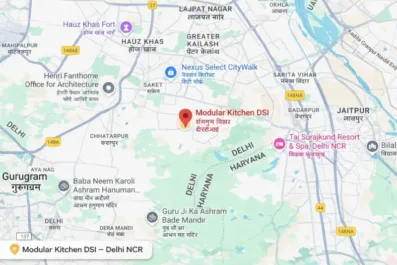
 View Modular Kitchen DSI on Google Maps